IQ Depletion intelligence platform

Finally, you can see
your own sales.

DepletionIQ turns the distributor spreadsheets you already receive into a live sales dashboard — from purchase order to shelf, across every account, in every state. Built for craft distilleries and wineries priced out of enterprise depletion software.

No software to install Live in 7 days Managed for you

Distillery owner desk with laptop showing DepletionIQ dashboard, bourbon glass, and distributor spreadsheet
Cases depleted · 4wk
247 ▲ 12.4%
Reorder alerts sent
14 accounts
Data freshness
6 min ago
The visibility chain

From purchase order to shelf.
All of it, finally in one view.

Once your product leaves the loading dock, most producers go dark. DepletionIQ closes the loop — every case tracked from the day the distributor cuts the PO to the moment it depletes at a bar, restaurant, or retailer.

Purchase Orders

Every distributor PO, normalized. See what's committed before it ships.

Depletions

Monthly case movement across every account, SKU, state, and distributor.

Reorder signals

Alerts when velocity says an account is 8–14 days from empty.

Tasting ROI

Every in-market tasting tied to the accounts it moved. And the ones it didn't.

Lift call lists

A printable priority list of accounts about to fall out. Before the shelf goes empty.

See the platform

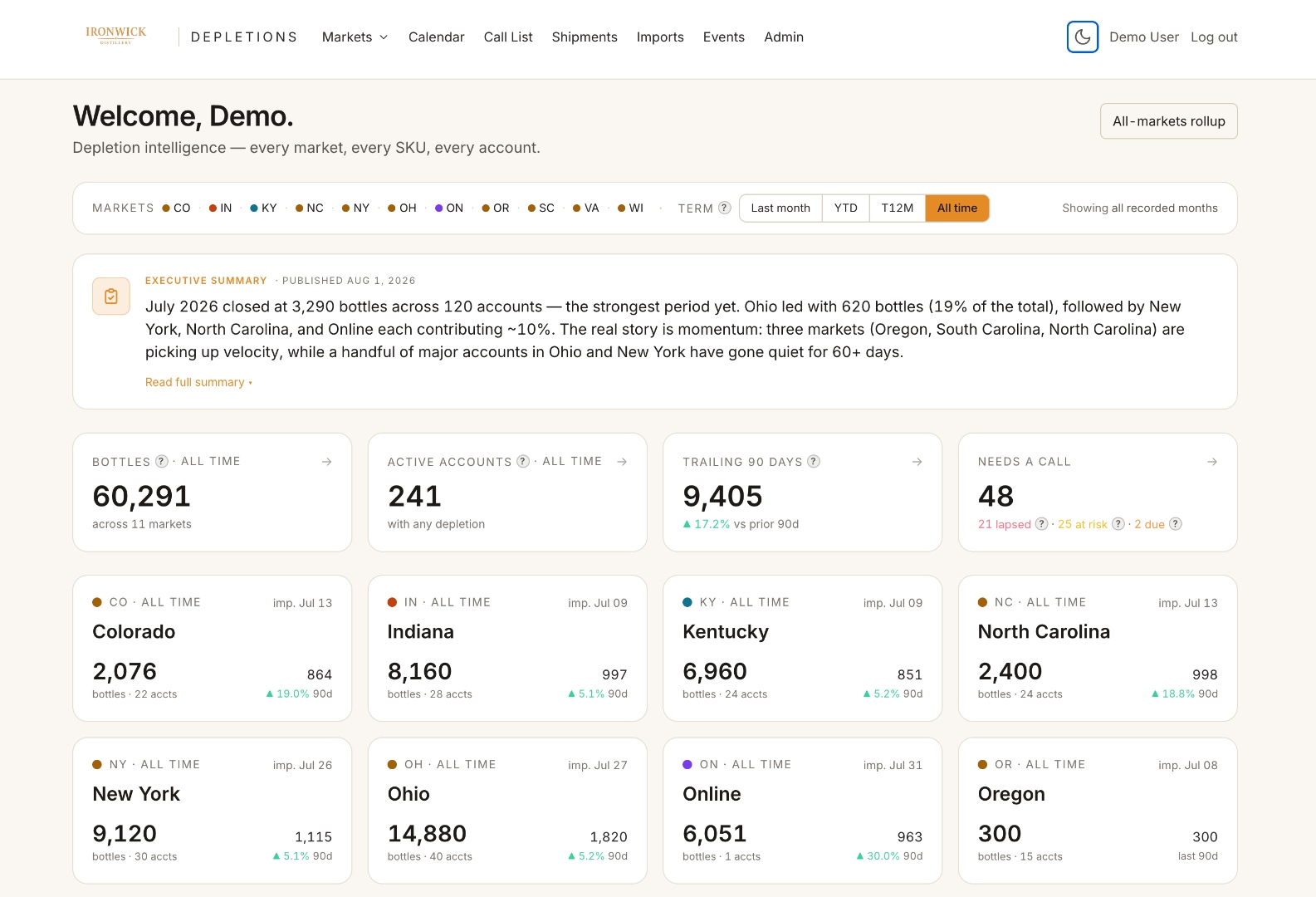
Your distributor spreadsheet, alive.

Same data your distributor sends you every month. Different picture.

demo.depletioniq.io / ironwick-distillery Live · 6 min ago
DepletionIQ live dashboard — Ironwick Distillery depletion intelligence across 11 markets, 241 accounts, 60,291 bottles all-time
Sales intelligence

Know where to invest.
Know where to pull back.

You can't be in every market at once. DepletionIQ tells you — in plain English — which bars, restaurants, and liquor stores deserve your next tasting, and where you're wasting cases on shelves that never turn.

Green · invest here

Accounts where every dollar compounds.

Momentum accounts, punching above their weight. Show up. Do the tasting. Add the second SKU.

  • Bars & restaurants trending +25% MoM velocity
  • Liquor stores with reorder cycles under 30 days
  • Markets where distributor pull-effort ROI clears 3×
  • SKUs gaining shelf depth without cannibalizing
Red · pull back

Cases sitting where they'll never turn.

Silent shelves. Dying rotation. Tasting spend that never converted. Redirect the effort before the reorder never comes.

  • Accounts with 60+ days since last depletion
  • Tastings that produced zero incremental case movement
  • Markets where additional supplier and distributor support may improve results
  • SKUs with declining velocity in previous reorder accounts

See your depletion data
the way it should look.

Send us one month of distributor reports. We'll return a live DepletionIQ view of your business in seven days — no contract, no committee, no software to install.

Book a demo
Field Notes

How the wholesale channel actually reports.

Research and practical guidance for craft distilleries — written for operators who read their own depletion reports.

All field notes
A rickhouse aisle of stacked bourbon barrels, warm light from a high window

Why DepletionIQ Exists: The Measurement Gap Between the Rickhouse and the Shelf

Craft distilleries move most of their volume through channels they cannot observe. A look at the structural reasons why, the market data behind it, and what closing the gap requires.

Read the post
Bourbon bottles on a backbar retail shelf, one facing slot empty

Reorder Velocity: Measuring Account Health Between Monthly Reports

Monthly depletion reporting introduces a structural lag between a change in account behavior and the producer's awareness of it. A look at the arithmetic, and at the days-to-empty metric that closes it.

Read the post
A printed distributor depletion spreadsheet on a desk beside a glass of bourbon

How to Read a Distributor Depletion Report: A Craft Distiller's Guide

A field guide to the monthly distributor report — what each column measures, the interpretation errors that carry real cost, a repeatable review process, and the questions the format leaves open.

Read the post