The short version: In the United States, most alcohol has to pass through three separate businesses before a consumer buys it. A producer sells to a licensed distributor, the distributor sells to a licensed retailer or bar, and the retailer sells to the consumer. Each tier is owned and licensed separately, and each one keeps part of the price. For a craft brand, the system also decides how much of your own sales you're allowed to see.
Most explanations of the three-tier system are about law. This one is about visibility. If you make spirits or wine and sell through distributors, the three tiers are the reason you can tell exactly what left your dock last month and almost nothing about who drank it.
Why the system exists
Before Prohibition, producers often owned the bars that sold their products. These "tied houses" pushed one company's products, competed on volume and were widely blamed for heavy drinking. When the 21st Amendment repealed Prohibition in 1933, it also gave each state the power to regulate alcohol inside its borders.
Most states used that power to build a wall between the people who make alcohol, the people who wholesale it and the people who sell it to the public. Those three walls became the three tiers. The goals were to stop any one producer from dominating local bars and stores, and to give the state a clear point to collect taxes and track product.
Because every state wrote its own rules, there isn't one three-tier system. There are about fifty versions of it.
Following one case from your dock to a glass
Picture a case of your bourbon leaving the distillery.
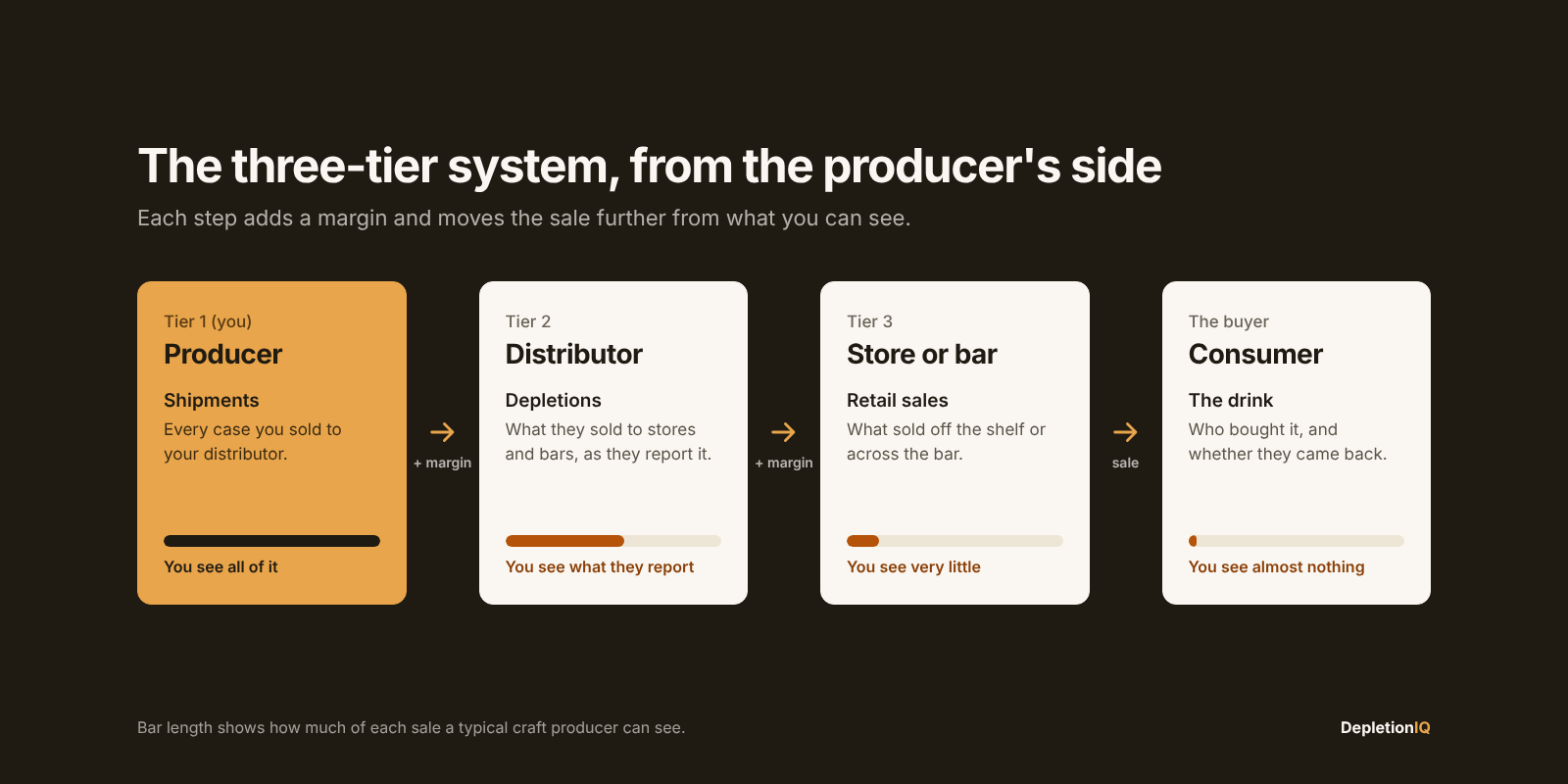
Tier 1: You, the producer. You sell the case to your distributor at your wholesale price. That sale is a shipment, and it's the last time you own the product.
Tier 2: The distributor. The distributor warehouses the case, sells it to stores, bars and restaurants, delivers it, collects payment and handles the state paperwork. They add their margin on top of what they paid you. When the case leaves their warehouse for an account, that's a depletion.
Tier 3: The retailer or bar. A liquor store puts the bottles on the shelf, or a bar pours them by the glass. They add their own margin and set the price the consumer pays.
Then the consumer. Someone buys a bottle or orders a drink. That's the sale you actually care about, and it's the one you're furthest from.
Every hand-off adds a markup and moves the product one step further from you. By the time the bottle is on a shelf, it may have passed through three owners and taken on two layers of margin.
What you can see at each tier
This is the part most explanations skip, and it's the part that shapes how a craft brand runs.
Your shipments: you see everything. You know every case you sold, to which distributor, at what price, on what date. It's your own invoice.
Distributor depletions: you see what they report. Your distributor knows exactly which accounts bought your product, but that information is theirs. What reaches you is a depletion report: usually monthly, in their own format, sometimes broken out by account and sometimes just a total by product. How much you get depends on the distributor and on how hard you ask. (See What is a depletion report?)
Retail sales: you see very little. What a store sold to consumers lives in the store's register. Large chains sell that scan data through syndicated data companies, but it's expensive and mostly covers big off-premise chains, not the independent stores and bars where many craft brands live.
The consumer: you see almost nothing. Unless someone buys at your tasting room, joins your list or follows you online, the person drinking your product is invisible to you.
Put simply: your view is sharpest where you have the least influence, which is your own dock, and blurriest where the buying decision actually happens, which is the shelf and the bar. Depletion data sits in the middle. It's the closest thing most craft producers have to seeing the market, which is why reading it well matters so much.
Not every state works the same way
Control states. In 18 jurisdictions, the state itself is the wholesaler for spirits, and in most of those it also runs or licenses the liquor stores. According to the National Alcohol Beverage Control Association, the control jurisdictions are Alabama, Idaho, Iowa, Maine, Michigan, Mississippi, Montana, Montgomery County (Maryland), New Hampshire, North Carolina, Ohio, Oregon, Pennsylvania, Utah, Vermont, Virginia, West Virginia and Wyoming. Getting listed with a control state is its own process, and the state often plays the role a distributor would elsewhere.
Self-distribution. Some states let small producers skip the middle tier and sell directly to stores and bars, usually with volume limits. It saves margin but turns you into a delivery and collections business.
Selling at your own place. Most states let distilleries and wineries sell bottles and pours on site, which is one of the few places you sell straight to the consumer.
Shipping direct to consumers. Since the Supreme Court's 2005 Granholm v. Heald decision, wineries can ship directly to consumers in most states. Spirits are far more limited: only about a dozen states plus Washington, D.C. currently allow distilleries to ship to consumers, most with tight volume limits. California's pilot program, which started in 2026, is one of the newest.
Distributor contracts. Distributors usually get exclusive rights to your brand in a territory, and some states have franchise laws that make changing distributors slow or expensive. Read the termination terms before you sign, not after.
What this means for a craft brand
- Your distributor is your data source. Ask for account-level depletions, in the same format every month. It's the most useful thing they can give you after orders. (See What should I ask my distributor for each month?)
- Don't mistake shipments for sales. A big shipment month can just mean your distributor stocked up. The real signal is accounts reordering. (See What's the difference between shipments, depletions and sell-through?)
- Every state is its own market. A control state, a self-distribution state and a franchise-law state need different plans. Compare them on the same terms before deciding where to grow.
- Use the tiers you can reach. Your tasting room, your field visits and your relationship with distributor reps fill in what the reports can't show.
The three-tier system isn't going away, so the job is to see through it as well as you can. That's why DepletionIQ exists: we take the depletion reports your distributors already send, in whatever format they come in, and turn them into one view of your accounts across every state. See how it works.
Quick answers
Is the three-tier system federal law? No. The 21st Amendment gave each state the power to regulate alcohol, so the three-tier system is built from state laws. That's why the rules change at every state line.
Can a distillery sell directly to stores and bars? In some states, yes, through self-distribution, usually only for small producers and with volume limits. In most states, spirits have to go through a licensed distributor.
Can I ship my spirits directly to customers? Only in about a dozen states plus D.C., and most limit how much one person can buy. Wineries have far more freedom than distilleries here.
What is a control state? A state where the government acts as the wholesaler for spirits, and often runs or licenses the liquor stores too. There are 18 control jurisdictions.
Why can't I see who buys my product? Because the sale to the consumer happens two tiers away from you, in a store or bar you don't own. Depletion reports from your distributor are the closest view most producers get.